Your Laptop's "AI Superpower" is Kinda Dumb (Compared to Real APIs)
Or: How I Learned to Stop Worrying and Love the Cloud.
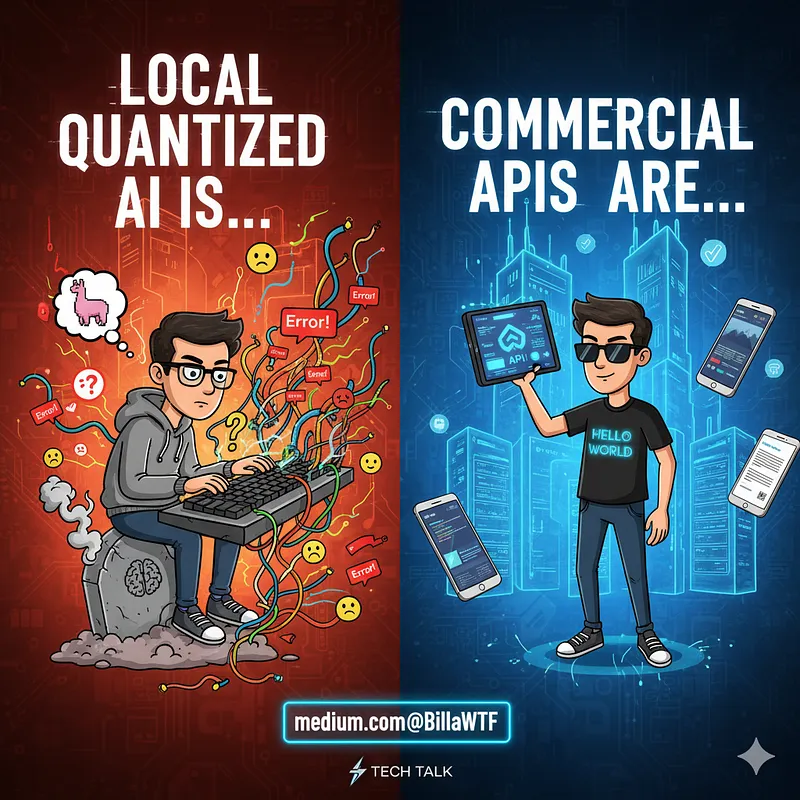
So you downloaded Llama 3 and it runs locally. Great! But let’s be real, your quantized model is like a butter knife at a sword fight when you compare it to a commercial API.
The Hype Train Has No Brakes
The hype is real. “Run Llama 3 on your laptop!” “Local AI is the future!” “Privacy! Control! No API costs!”
We’ve all seen the videos: a terminal window whirring, a fan spinning like a jet engine about to achieve liftoff, and then… a perfectly coherent (mostly) response appears. It feels like magic. It feels like you’ve unlocked some forbidden computational power right there on your 2019 MacBook Pro that’s held together with stickers and prayers.
And it is cool. Seriously, the engineering behind making massive language models run on consumer hardware is nothing short of incredible. The people who figured out how to compress a 70-billion-parameter model into something that fits on a laptop deserve medals, stock options, and probably some kind of engineering knighthood.
But let’s pump the brakes on calling it a “superpower” just yet.
Because the moment you pit your quantized, local model against a commercial API, it quickly becomes clear you’re bringing a butter knife to a sword fight. And not even a sharp butter knife. Like one of those airline butter knives that couldn’t cut warm butter if its life depended on it.
The Reality Check Nobody Asked For
Here’s what actually happens when you run AI locally:
You: “I’m going to run this 7B parameter model on my laptop!”
Your laptop: starts making the sound of a 747 taking off
Your electricity bill: begins sweating nervously
The model: “Sur…e… let… me… think… about… that…”
[5 minutes later]
The model: “The capital of France is… checks notes …Pari — wait, let me recalculate that…”
Meanwhile, in the cloud:
GPT-4: responds in 0.3 seconds with a perfectly formatted essay, three code examples, and a haiku about your question
The Quantization Compromise
Let’s talk about quantization. It’s the magical process that makes these models small enough to run on your hardware. Basically, it’s like converting a 4K movie into a 240p YouTube video from 2007. Sure, you can technically still watch it, but did you really need to see every pixel of that explosion?
The math goes from precise floating-point numbers to “ehh, close enough” integers. Your model went from a PhD mathematician to that friend who always rounds up when splitting the dinner bill.
Full precision model: “The square root of 2 is 1.41421356237…”
Your quantized model: “The square root of 2 is… like… 1.4-ish? Maybe 1.5? Depends on the vibe, honestly.”
The Speed Dilemma
Running local AI on your laptop is like cooking a five-course meal on a camping stove while Gordon Ramsay has a full industrial kitchen next door.
Prompt: “Write a Python script to analyze this dataset”
Local Model:
- Tokens per second: 3
- Time to complete: 45 seconds
- Your laptop’s temperature: Surface of the sun
- Your laptop’s battery life: “LOL”
- Response quality: 7/10 (it tried)
API (GPT-4/Claude):
- Tokens per second: 50+
- Time to complete: 3 seconds
- Your laptop’s temperature: Room temperature
- Your laptop’s battery life: Unchanged
- Response quality: 9/10 (and it included error handling you didn’t ask for)
The “But Privacy!” Argument
Yes, yes, I hear you. “But what about privacy? What about not sending my data to Big Tech?”
Look, I get it. If you’re processing top-secret documents or your company’s proprietary code, absolutely use a local model. That’s valid. That’s smart.
But let’s be honest about what most of us are actually doing:
- “Write me a function to reverse a string”
- “Explain async/await like I’m five”
- “Fix this CSS that’s making my div float into the shadow realm”
- “Write a haiku about my debugging session”
Google already knows all of this about you from your search history. We’re not exactly protecting the nuclear launch codes here.
The Cost Argument Falls Apart Fast
“But APIs cost money!” you cry, clutching your free local model.
Let’s do some math:
Running locally:
- Electricity cost: ~$0.20/hour (your laptop at full throttle)
- Time spent waiting: Your actual hourly rate × hours wasted
- Therapy costs for fan-induced PTSD: $150/session
- New laptop because you cooked your old one: $1,200
Using an API:
- GPT-4 API: ~$0.01 per request
- Your sanity: Intact
- Your laptop: Alive
- Your productivity: Actual productivity
Unless you’re processing thousands of requests per day, the API is probably cheaper. Especially when you factor in the “not cooking your hardware” savings.
The Context Window Tragedy
API models: “I can remember up to 200,000 tokens of context!”
Your local model: “I can remember… what were we talking about again?”
Trying to feed your local model a long document is like trying to explain the entire Marvel Cinematic Universe to your goldfish. Sure, you can try, but it’s going to forget everything from the first movie by the time you get to Endgame.
When Local Actually Makes Sense
Okay, real talk. There are legitimate use cases for local AI:
- Actual Privacy Concerns: Processing medical records, legal documents, or classified information
- No Internet Access: Working on a submarine, in a bunker, or in rural Montana
- Learning: Understanding how these systems work under the hood
- Experimentation: Fine-tuning models on your specific data
- Memes: Creating a bot that only speaks in Shrek quotes (no judgment)
If you’re doing any of these things, local AI is your friend. Keep fighting the good fight.
The Uncomfortable Truth
Here’s the thing nobody wants to admit: for 99% of use cases, commercial APIs are just… better. They’re faster, smarter, more reliable, and they don’t turn your laptop into a space heater.
Your quantized Llama 3 is like a really smart intern who’s had three hours of sleep and four energy drinks. Sure, they’ll get the job done eventually, but do you really want to bet your production system on it?
Meanwhile, GPT-4 is like hiring that annoyingly competent coworker who somehow finishes everything early and still has time to organize the office Secret Santa.
The Conclusion You Already Knew
Look, I’m not saying you shouldn’t run AI locally. It’s fun, it’s educational, and it makes you feel like a hacker in a movie (even though you’re just running python main.py).
But let’s stop pretending that your laptop running a quantized model is going to replace commercial APIs anytime soon. It’s like comparing a bicycle to a Tesla and insisting the bicycle is better because “it’s more authentic.”
Local AI is amazing technology. It’s democratizing access to machine learning. It’s pushing the boundaries of what’s possible on consumer hardware.
But it’s still bringing a butter knife to a sword fight.
And honestly? Sometimes it’s okay to just use the sword.
P.S.
If you’re still convinced that your local setup is superior, I respect your conviction. I also respect flat-earthers and people who think pineapple belongs on pizza. We all have our beliefs.
Just maybe invest in a good cooling pad.
And perhaps a fire extinguisher.
You know, just in case.
Written while my laptop fan screamed in the background and Claude API generated responses faster than I could type them. The irony is not lost on me.
Also published on Medium.
Ask the archive
Got a question about this or anything else here? Ask, and get the passage that answers it — from all 97 posts, in your browser.