My Recycling App Did 3 Pivots and 0 Recycles. A Post-Mortem.
I was gonna save the planet. With code. Here's how zylobin failed spectacularly.
I was gonna save the planet. With code.
Yeah, I know. Every developer has that one grand, world-changing idea they sketch out at 2 AM, fueled by cold pizza and delusion. Mine was zylobin. The name was cool, the mission was noble: solve recycling.
The plan was brilliant. A full-stack, multi-platform, cloud-native, blockchain-ready (okay, maybe not blockchain) ecosystem to connect people who have trash with places that want trash.
The **v0.1** Master Plan 🚀:
- A sleek mobile app for the People™: Users would religiously scan every plastic bottle and cardboard box, track their recycling stats like a high score, and feel smug about their carbon footprint. When it was time to drop off, they’d find a collection point on the map, scan a QR code on the bin, drop their stuff, and get rewarded with glorious, gamified points.
- A powerful dashboard for the Industry™: Recycling collection companies would log into their web portal, manage their fleet of bins across the city, update waste types, and see real-time analytics.
It was a perfect two-sided marketplace. A beautiful, symbiotic relationship. The Uber for your garbage. What could possibly go wrong?
Well, step one of a two-sided marketplace is talking to… you know… both sides. And talking to actual collection companies sounded like phone calls. And meetings. And spreadsheets. It sounded a lot like work.
My developer brain found a much more elegant solution.
The First Pivot: git commit -m "feat: make users do all the work"
Why bother with businesses when you can just crowdsource it?
I yeeted the entire dashboard web app into the digital void. The new plan was simple: let users add the recycling bins to the map themselves. They could pin a location, add a photo, and report what kind of waste it accepts.
Brilliant, right? I just cut my workload in half. zylobin was no longer a complex B2B2C platform. It was now a Waze for trash cans. A bin finder.
The app went live. I waited for the downloads to pour in. And they… didn’t.
A few friends downloaded it, added the bin outside their apartment, and never opened the app again. I had built a solution to a problem that didn’t exist. People who are motivated enough to recycle already know where the bins are. People who aren’t motivated aren’t going to download an app to find one.
The app had exactly one use case: you’ve just moved to a new city, you’re holding a single empty bottle, and you’re irrationally passionate about not throwing it in a regular trash can. The total addressable market was maybe… 7 people.
The Second Pivot: npm install more-features
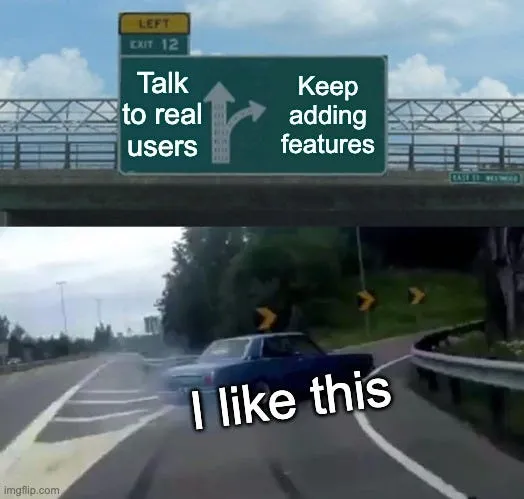
My app was failing. My user count was flatlining. My motivation was draining.
So I did what any good developer does when their product has zero market fit: I added more features.
If people don’t want a bin finder, maybe they want… a marketplace for their trash?
Yes. A “Waste Sharing Marketplace” was born. Users could now list their “gently used cardboard” or “artisanal glass bottles” for other users to claim. Maybe someone needed boxes for moving? Maybe a crafter needed bottle caps?
I went all in. I added a bidding system. User profiles. A rating system. A direct messaging feature. The codebase became a beautiful, tangled mess of spaghetti that would make an Italian chef weep.
zylobin was now a bin finder, a social network, and a Craigslist for garbage, all rolled into one confusing, bloated app that solved precisely zero problems for zero people.
The Inevitable End: The rm -rf / of Motivation
After months of coding features nobody asked for, for an app nobody needed, I finally burned out.
The project was dead. I stopped working on it. zylobin now sits in a private GitHub repo, a digital monument to my own hubris. It never processed a single piece of recycled waste.
So, What Was the Actual Problem?
Looking back, the failure was obvious. I was so in love with my solution that I never truly understood the problem. I coded for months without having a single real conversation with a user or a collection company.
If I were to start over, here’s what I would have done:
GET OUT OF THE EDITOR. Forget the code. The first step is to go talk to the actual players.
- Talk to Collection Companies: What sucks about their job? I’d bet my bottom dollar their problem isn’t “not enough people know where our bins are.” It’s probably something like:
- “Our trucks waste fuel checking on empty bins.”
- “Our bins are constantly overflowing before we can get to them.”
- “People contaminate the recycling with actual garbage, costing us a fortune.”
- Talk to People: Why don’t they recycle more?
- “I have no idea what’s actually recyclable.”
- “It’s inconvenient.”
- “Does it even make a difference?”
SOLVE ONE, TINY, PAINFUL THING. Instead of building an “ecosystem,” I could have built a single, razor-focused tool.
- For companies: What if I built a simple system with cheap IoT sensors that just pings them when a bin is 80% full? That’s it. No user app. Just a dashboard that optimizes their truck routes, saving them thousands on fuel and time. That’s a product you can sell.
- For people: What if the app did only one thing: you take a picture of an item, and it tells you “YES, RECYCLE” or “NO, TRASH.” Use a simple ML model. It solves the problem of confusion and contamination. That’s an app people might actually use.
The lesson is brutal and simple. Don’t build features. Build solutions. And you can’t build a solution until you leave your ergonomic chair, walk outside, and ask people what their problems are.
Otherwise, you’ll just end up like me, with a perfectly engineered, feature-rich app in a digital landfill.
Also published on Medium.
Ask the archive
Got a question about this or anything else here? Ask, and get the passage that answers it — from all 97 posts, in your browser.